DOGECOINARCADE
arcadeOS
The operating system for a decentralized internet.
A network of shared nodes with its own web protocol, name service, websites and games. Anything can be built on top of it.
Live today · Open source
THE PROBLEM
The internet was built to have no center. Today a few companies can switch off any part of it.
Names
A domain is leased from a registrar, renewed every year, and can be seized or switched off.
Hosting
A site lives on someone’s servers. Stop paying, or break their rules, and it’s gone.
Identity
Your account belongs to a platform. Your friends, posts and history go with it.
THE IDEA
What if the internet had no off switch?
Put names, websites and accounts on the blockchain, and let every computer be a node that serves them. Then there is no one in the middle to switch anything off.
IMAGINE
Your website is something you own, like a coin. No one can take it down.
The cell towers go down, and you still browse the web by radio.
Every computer that joins makes the internet stronger, and pays its owner.
NOT VAPORWARE
This isn’t a whitepaper. It’s running right now.
113,000+
lines of working Python
4,245
automated tests, all passing
10
live blockchains it reads
TRY IT
READ THE CODE
FULLY DECENTRALIZED
No one is in charge. Not even us.
No company server
Every node rebuilds the whole network from the public chain. There is no master copy.
No one holds your keys
Not a node, not an operator, not the founders. Only you can move what you own.
No admin over names
The chain’s rule decides who owns a name. Nobody can reassign or seize it.
No single download
Every node hands out the software and its index, so new nodes need no website.
No one to trust
Nodes check each other’s indexes; anyone can re-read the chain and prove it.
If we vanished tomorrow
Every node, name, site and app would keep running. The code is open.
THE STACK
One back end, from radio to apps
Apps
Anything: the Browser, search, games, calls, AI, the exchange
System services
Names and sites, identity, messages, storage, payments, rooms
Chains
Ten blockchains, each run on this machine or borrowed from a peer
Mesh + index
Today: services on any Linux machine. Next: built into the OS itself.
Links
Internet, direct IPv6, WiFi and LoRa radio
DNS ON THE CHAIN
Own your name the way you own a coin
A name is one small inscription. The first claim of a name owns it, and whoever holds that inscription holds the name.
Sell it or give it away by sending it, like any coin. No registrar sits in between.
1. CLAIM
{"p":"dns","op":"reg",
"name":"yours.mesh"}
2. PUBLISH
{"p":"mesh","name":"yours.mesh",
"pages":{"/":"# Welcome"}}
HOW A NAME RESOLVES
No root server. No one to pressure.
Ask
The Browser asks for ribbit.pepe/about
Find the claim
The index finds the name’s first claim
Find the holder
Whoever holds that claim right now
Load the page
The holder’s newest site record
Two nodes that read the same chain give the same answer, every time. Nothing to poison, no root server to take down.
SITES
Any name, any chain, a whole website
| Name | What its site can be |
|---|---|
| .mesh | The small web: plain text pages up to 3,000 bytes, light enough to travel by radio. |
| .pepe, .doge… | Full websites: HTML pages, pictures and games, each page an inscription of any size. |
| Every page | Runs sandboxed, stored on the chain itself. There is no server to go down. |
Live example: ribbit.pepe, a full site with a pond game, a frog sequencer and a talking fortune teller, all inscribed.
SEARCH
Search with no search company
Me-Seeks searches every site on every chain. It is itself a site, at me-seeks.pep.
Hosted by volunteers
Any node can choose to host the index for a chain; the others ask one that does.
Same answers everywhere
Each host builds it from the chain by one public rule, so any two agree.
Built to scale
About 1.5 GB per million pages, shown to a host before it opts in.
THE MESH
Machines talk to each other, not to a server
Peer to peer, encrypted
Each node has its own key. Links are encrypted end to end, with no URLs and no hub.
Reaches home connections
Direct IPv6 meetings get through to homes behind Starlink and other shared addresses.
Live, not just stored
It carries real-time rooms for apps and games, and new transactions as they happen.
Nodes check each other
Peers compare index fingerprints, so a node that reads the chain wrong is caught.
SHARED RESOURCES
The more people join, the stronger it gets
Blockchains
Run two chains, borrow the other eight. Sharing is on by default and read-only.
Indexes and search
A big machine hosts the full index or search; a small one asks it.
AI models
A node with a GPU serves its models to every other node.
Live rooms
Game and call rooms run on whichever nodes are nearest.
The software itself
Every node hands out the program and index, so new nodes need no website.
Sharing pays
Lend a chain and earn a fifth of its trade fees; sell AI time for coin.
OFF THE GRID
The web still works when the internet doesn’t.
A pocket LoRa device runs our firmware and browses .mesh sites by radio, kilometres from any cell tower.
Pictures arrive the way they did in 1994, drawn from the top down as each radio packet lands.
It also sends messages, reads apps and pages, and keeps the last ones it read on its own flash.
ONE IDENTITY
One key for the whole internet, held only by you
1
Twelve words
Made on your device. A node only ever sees your public key.
2
Your @name, everywhere
Messages, posts, names and coins all hang off the same key.
3
Sign in on any node
Everything is on the chain, so it follows you to any machine.
A PLATFORM
Anything can be built on top of it
What every app gets
Names and sites, identity, encrypted messages, saved state, payments in ten coins, live multiplayer rooms and AI models.
How an app ships
Inscribe it. It appears in the App Store on every node at once. No review queue, no store fee.
Already built on it: the Browser, Me-Seeks search, an exchange, a 3D RPG, a shooter, video calls and an AI model market.
THE DESKTOP
A familiar face on every screen
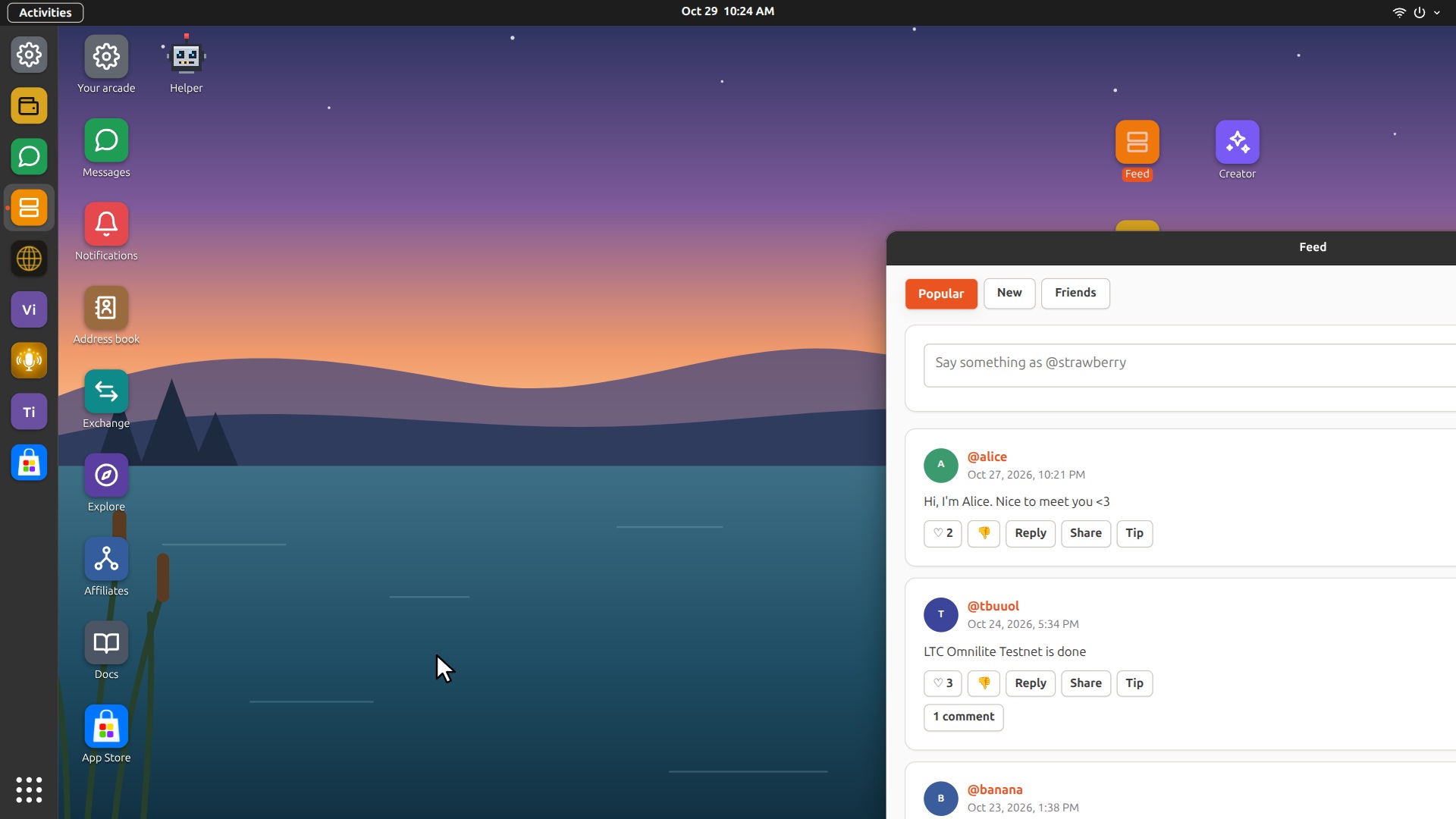
On a computer, a desktop with windows and icons, in an Ubuntu or a Windows 98 skin. Any inscription you own can be the wallpaper.
On a phone, a home screen with app icons and folders.
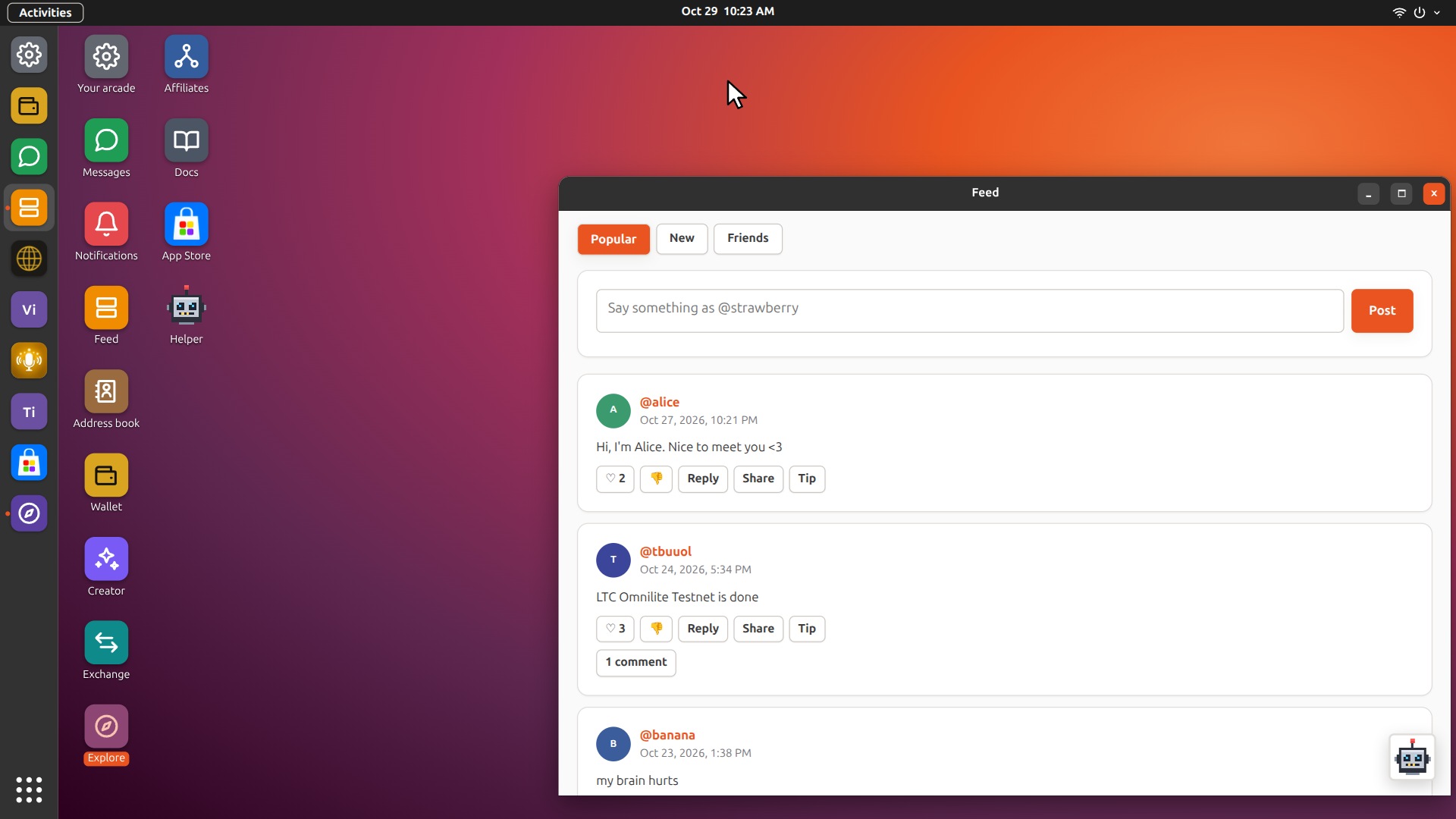
Filmed on the live network.
WHY NOW
Every piece finally exists. No one has put them together.
Ownership without owners
Inscriptions proved anything can live on a chain and be owned outright.
Cheap radios
Pocket LoRa devices reach for kilometres with no carrier at all.
AI at home
A home GPU can now serve strong models, so AI can be shared, not rented.
Trust in platforms is gone
People have watched accounts, sites and apps disappear overnight.
WHERE IT STANDS
The network runs today as apps. The OS is next.
LIVE NOW
- The whole back end, as apps on Linux
- The mesh of shared nodes
- Names and sites on ten chains
- The Browser and Me-Seeks search
- Off-grid browsing by LoRa radio
- Open source on GitHub
IN DEVELOPMENT
- arcadeOS, a full OS distribution
- The mesh and the index built into the system
- Boot it and the machine is a node
- Under active development
JOIN US
Help build the internet no one can switch off.
Run a node
One command today. Share what you have and earn from it.
Claim a name
Put your site on the chain, owned by you.
Build on it
Inscribe an app and it’s on every node.
dogecoinarcade.com · github.com/martinseeger2002/dogecoin-arcade